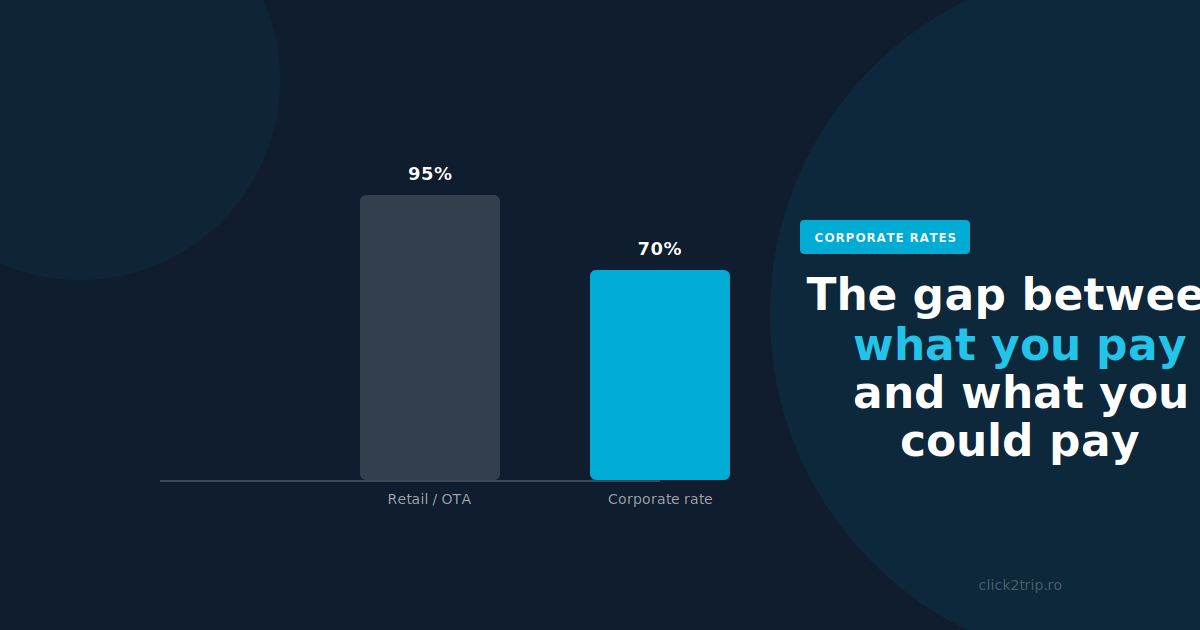
There’s a price that shows up on Booking.com when one of your employees searches for a hotel. Then there’s the price that a company with a managed travel programme pays at the same hotel, on the same night. The gap between these two numbers is typically 15–30% — and it exists because hotels price differently depending on who’s buying and how.
Why hotels offer lower rates to managed accounts
A hotel’s biggest operational challenge is revenue predictability. A company that sends 40 room nights per month, consistently, across different seasons — that’s a materially better customer than 40 individual travellers who each might or might not come back. Hotels reflect this in their pricing: consistent, predictable volume earns consistently better rates.
The negotiation happens either directly between large companies and hotel chains, or through a travel management partner who aggregates volume across multiple clients. Either way, the hotel is making the same calculation — it’s offering a discount in exchange for a revenue stream it can count on.
What corporate rates actually include
The rate is only part of it. A negotiated corporate rate typically also includes:
- Flexible cancellation — usually free up to 24–48h before arrival, versus the non-refundable rates that appear cheapest on consumer platforms
- Guaranteed availability — corporate contract rooms are held separately from publicly available inventory, which matters during peak periods and local events
- Proper invoicing — a tax invoice issued to the company, with the correct VAT breakdown, rather than a Booking.com receipt that your finance team can’t process cleanly
- Breakfast inclusion — often negotiated as part of the rate package rather than charged separately
- Direct billing — for high-volume accounts, the hotel bills monthly rather than charging a card at each checkout
The invoicing problem is bigger than it looks
If your employees book hotels on personal cards and expense them, your finance team is processing individual receipts — often from OTAs rather than from the hotel directly, in the OTA’s name, without Romanian VAT, and sometimes in a currency other than the one the hotel operates in. Each receipt requires manual review, and VAT that could be recovered is frequently lost because the documentation doesn’t support recovery.
A managed hotel programme consolidates this into a single monthly invoice per hotel or per programme, with correct documentation, in the format your accounting team actually needs. The admin saving alone often justifies the programme without even counting the rate difference.
What volume is enough to negotiate?
More than most companies think. A business doing 15–20 hotel nights per month in a single city has enough volume to negotiate a rate at hotels in that city. A business doing 50+ nights per month across multiple cities can structure a programme across multiple properties.
For companies below these thresholds, working through a travel management partner who aggregates volume across their client base achieves the same result — the hotel sees a consistent, meaningful revenue stream regardless of whether it comes from one company or several.
What to watch out for: the attrition clause
Negotiated hotel rates usually come with an attrition clause — a commitment to use a minimum percentage of the rooms you’ve agreed to (typically 80–90%), with a financial penalty if you fall short. This is standard, but the terms are negotiable: the percentage, the deadline for releasing unused rooms without penalty, and the penalty rate per room.
Before signing any hotel contract, make sure someone — whether an internal travel manager or your TMC — has reviewed the attrition clause and understands exactly what exposure it creates if travel plans change.
Want to know what rates we could negotiate for your typical hotel destinations? Reach out at Click2Trip — no commitment, just a real answer.