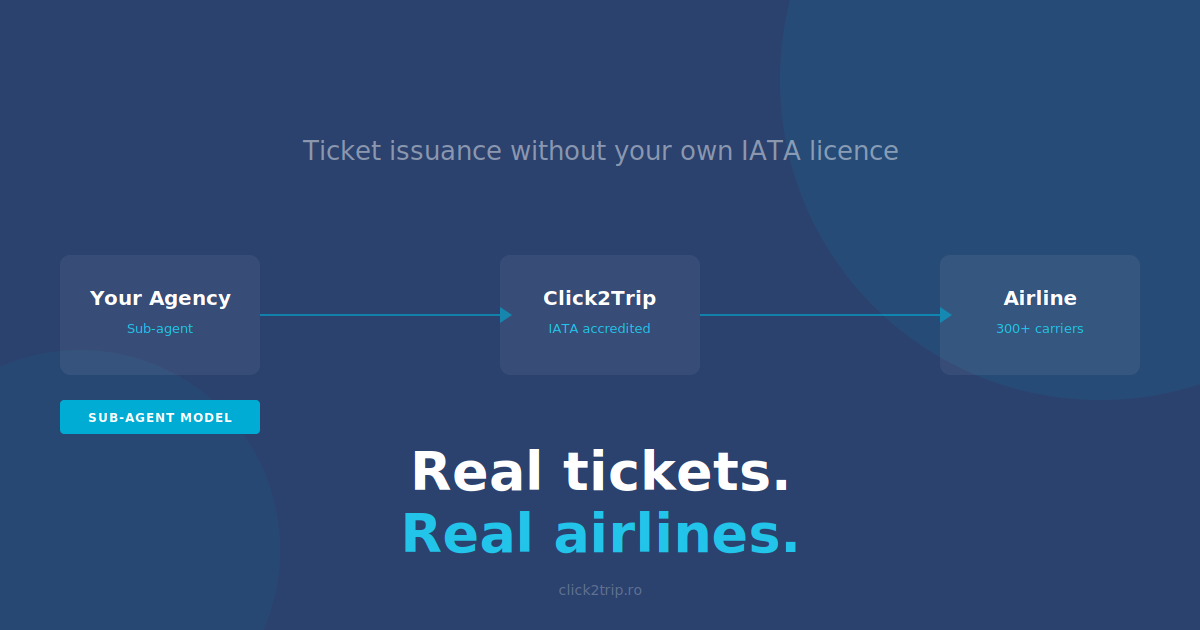
One of the most common misconceptions in the travel industry is that issuing airline tickets requires your own IATA accreditation. It doesn’t. The sub-agent model — where an agency books and sells tickets through an accredited partner — is a standard, fully regulated structure that accounts for a significant share of airline tickets sold globally. Here’s how it actually works.
What IATA accreditation actually gives you
An IATA accreditation gives an agency direct access to the Billing and Settlement Plan (BSP) — the financial infrastructure through which ticket sales are reported to airlines and settlements are processed. It comes with a numeric agency code, the ability to issue tickets directly, and a set of compliance and financial obligations including annual fees and in some programmes, a bank guarantee.
The accreditation process takes 6–12 months for a new applicant, has real costs, and requires ongoing compliance management. For agencies at scale, it makes complete sense. For agencies focused on serving clients rather than managing regulatory overhead, the sub-agent model is a better-structured alternative.
How the sub-agent model works in practice
When a sub-agent books through Click2Trip, the workflow is straightforward: the sub-agent searches and selects the flight through our platform — accessing the same GDS inventory (Amadeus, Sabre, Travelport) that any accredited agency uses. The booking creates a PNR in the airline’s own reservation system. We then issue the ticket through our IATA accreditation and BSP connection.
The resulting document is a genuine IATA e-ticket with a standard 13-digit ticket number and full carrier validation. It is accepted at check-in on any airline worldwide, eligible for changes and refunds under the fare rules, and identical in every functional way to a ticket issued directly by an accredited agency. The issuing entity is Click2Trip — which means the sub-agent has a direct point of contact for any post-booking support, rather than navigating airline contact centres independently.
What the sub-agent doesn’t need to manage
The BSP reporting, the financial settlement with airlines, the compliance obligations, the bank guarantee — these sit entirely with Click2Trip. The sub-agent books, earns their margin, and focuses on client relationships. The regulatory complexity stays on our side of the partnership.
Is it legal and compliant?
Completely. IATA explicitly recognises and regulates the sub-agent relationship. The accredited agency (Click2Trip) takes responsibility for the sub-agent’s bookings within the BSP framework — this is a defined, documented structure in the IATA agency programme rules, not a workaround. It’s how a substantial portion of tickets are sold through travel agencies in every major market.
What to look for in a sub-agent partnership
Not all IATA-accredited agencies offer sub-agent access, and those that do vary significantly in what the partnership includes. Key things to verify: the accredited agency’s standing (are they in good standing with IATA, with no BSP defaults?), the breadth of inventory they can access, the fee structure for sub-agent bookings, the support model for post-booking changes, and the technology platform through which you’ll work.
A sub-agent partnership should feel like an extension of your own capabilities — not a bureaucratic bottleneck between you and your clients’ bookings.
If you’re a travel agency in Romania looking to offer flight ticketing without going through the full IATA accreditation process, talk to us at Click2Trip.